
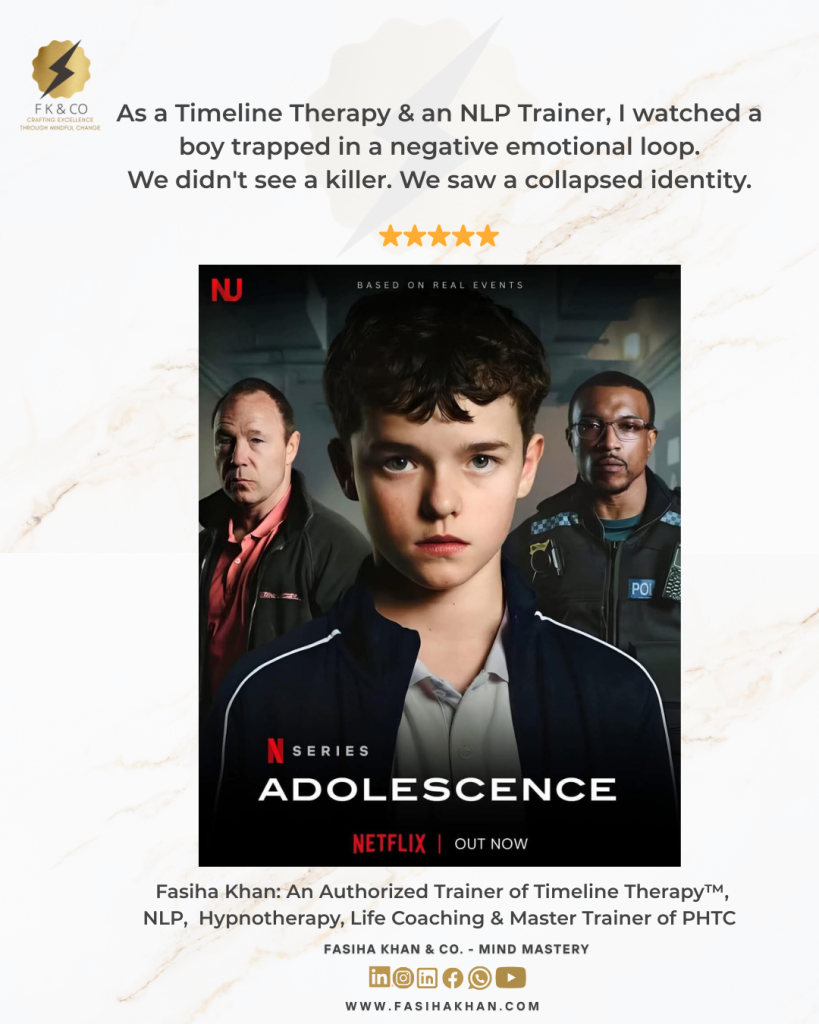
I never review shows. But Adolescence forced me to speak. Not because it’s entertaining television (though it’s brilliantly made), but because it exposes a crisis we’re all failing to address and being a Trainer of Timeline Therapy, Neuro linguistic , a Homeschooling Mother and therapist I am seeing real life cases around me. So here it is…
This isn’t just another true-crime drama. It’s not about solving a mystery or sensationalizing violence. It’s a brutal, necessary mirror held up to society, forcing us to ask: How does a 13-year-old boy from a “good home” end up killing a classmate?
And more importantly, how many more boys are on the same dangerous path without us even realizing it?
1. The Genius of What Adolescence Doesn’t Do
Most crime stories about troubled teens follow a predictable script:
– Dysfunctional family? Check. (Abusive dad, alcoholic mom, etc.)
– Poverty or trauma? Check.
– Race as an easy scapegoat? Unfortunately, often check.
But Adolescence refuses all of these tropes.
Jamie’s Family Is… Normal. (That’s the Point.)
Jamie Miller isn’t from a broken home. His parents aren’t divorced. His father doesn’t beat his mother. They’re not poor. They’re not neglectful. They’re just… ordinary.
– Loving but imperfect parents who think they’re doing enough.
– A stable, middle-class home where dinner is served on time.
– No glaring red flags; just the quiet, everyday blind spots that let a child slip through the cracks.
This was a brilliant creative choice. Because if Jamie had come from a “bad” background, we’d dismiss him as an exception. Instead, Adolescence forces us to confront an uncomfortable truth:
Violence isn’t born in “bad” homes. It’s nurtured in the gaps we ignore.
Jamie Is White; And That’s Intentional
The show’s creators deliberately made Jamie a white, middle-class boy. Why?
Because if he had been Black, Brown, or from a marginalized community, certain viewers would have dismissed this as a “those people” problem.
But this isn’t about race. It’s about how society fails boys, period.
By removing racial stereotypes, Adolescence makes its message universal: This could be your son. Your neighbor. Your student.
2. The Slow Unraveling of a 13-Year-Old Boy
The show opens with Jamie’s arrest for killing Katie Leonard, a girl from his school. We know what he did from the start. The real question is why?
The Digital Descent
Jamie wasn’t born violent. But like countless boys today, he was preyed upon by an online ecosystem that exploits insecurity.
– Instagram & YouTube algorithms fed him endless “alpha male” content.
– Peers reinforced toxic masculinity; mock him for not being “man enough.”
– Katie’s public rejection wasn’t just humiliation it was the final crack in an already fragile identity.
The most chilling part? All of this happened in plain sight.
Parents, teachers, and police had no idea how deep Jamie’s rage went; because they weren’t speaking his digital language.
The Detention Room Breakdown
One of the most heartbreaking scenes happens in juvenile detention, where a psychologist assesses Jamie.
– She gives him a sandwich with ingredients he hates. He forces himself to eat it, terrified of displeasing her.
– When asked about girls, he lies about sexual experiences, terrified of seeming weak.
– He mutters, “I’m ugly,” with such conviction it feels like a lifetime of internalized shame.
– His desperate plea: “Do you like me?” Not as a flirtation, but as a child begging for validation.
This is where Adolescence shines. It doesn’t excuse Jamie’s crime; but it forces us to see how a boy’s mind can twist into something unrecognizable when his pain goes unheard.
3. The Society That Failed Jamie (And Is Failing Your Son Too)
Adolescence isn’t just about one fictional boy. It’s about all the systems that failed him:
1. Tech Companies
– Profit from boys’ loneliness while denying responsibility for toxic content.
– Algorithms push extreme masculinity but offer no healthy alternatives.
2. Schools
– Focus on grades, not emotional intelligence.
– Miss warning signs because “he’s just being a boy.”
3. The Justice System
– Treats damaged children like adult criminals.
– Offers punishment, not healing.
4. Parents (Including Me)
– Assume “good kids” don’t need deep conversations.
– Avoid monitoring digital lives because it feels invasive.
– Dismiss moodiness as “just a phase.”
5. The “Man Box” Culture
– Boys learn early: Emotions = weakness.
– They’re starved for real connection but punished for seeking it.
– Their rage has nowhere to go; until it explodes.
4. What Do We Do Now?
This show isn’t just a warning. It’s a call to action.
For Parents:
– Stop assuming “not my kid.”
– Learn their digital world not to spy, but to understand.
– Teach boys that vulnerability is strength.
For Schools:
– Prioritize mental health as much as math.
– Train teachers to spot silent crises.
For Society:
– Hold tech companies accountable.
– Demand juvenile justice reform.
– Break the “Man Box” before it breaks more boys.
Final Thought: The Jamie in Your Life
The scariest part of Adolescence?
Jamie isn’t a monster. He’s a product of a world that doesn’t listen to its boys.
So I’ll leave you with this:
Who is the Jamie in your life?
– The quiet boy who jokes a little too darkly?
– The “class clown” who seems fine but never talks about his feelings?
– The son who says “I’m okay” but won’t meet your eyes?
Adolescence isn’t just a show. It’s a wake-up call.
Will we hit snooze or finally start listening?
By:Fasiha Khan
Fasiha Khan is An Authorized Trainer of Timeline Therapy™, NLP, Hypnotherapy, Life Coaching & Master Trainer of PHTC ( Parenting Homeschooling Training Course)
#BreakTheManBox#ListenToBoys#AdolescenceNetflix#FasihaKhan#ummahhomeschooling